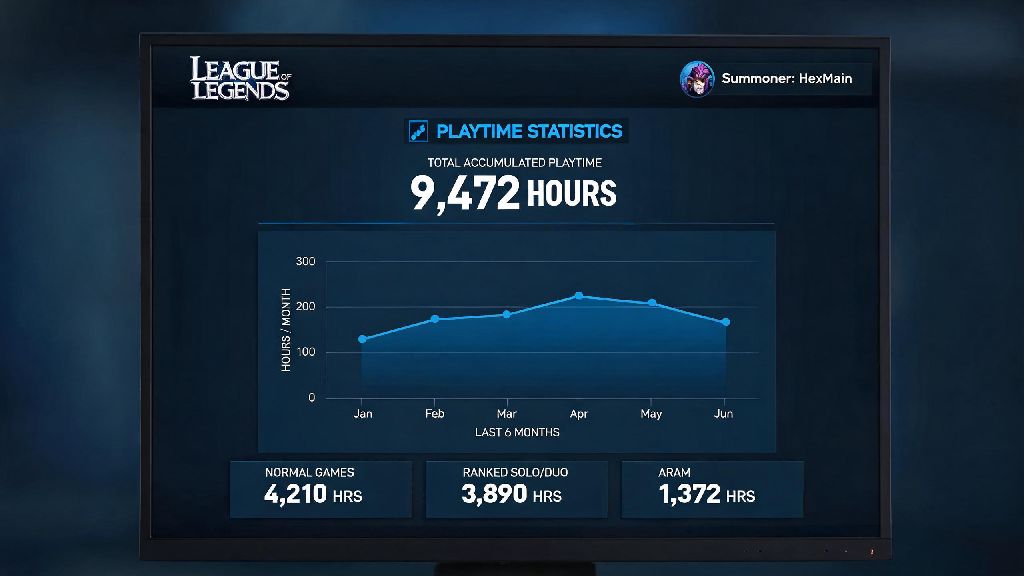
If you’ve ever had a friend tease you for spending more time on Summoner’s Rift than you do on your college assignments or side hustle, you’ve probably wondered how to check league of legends hours to see if their joke is actually true. Riot doesn’t exactly advertise this stat front and center in the client, so a lot of players assume there’s no easy way to pull up their total playtime, especially for accounts that are years old. The good news is you have multiple options to get this number, ranging from official Riot tools to reputable third-party trackers, each with their own pros and cons depending on what you’re looking for. We’ll walk you through every method, what to watch out for to keep your account safe, and how to fix common issues if your playtime count looks off.
How to Check League of Legends Hours Using Riot's Official Client
This is the first method most players try, and for good reason. It’s built directly into the LoL client, so you don’t have to leave the app or share any of your account details with external sites. To find the stat, open your LoL client, click on your profile icon in the top right corner, then select the “Stats” tab from the menu on the left side of the screen. Scroll down past your ranked stats and recent match history, and you’ll see a total playtime count for matchmade games. The official method is the only 100% safe option for checking playtime, as there’s zero risk of phishing or account compromise when you use Riot’s own tools. That said, it has some pretty big limitations for long-time players. Riot only started tracking full playtime data for most regions in late 2020, so any matches you played before that date won’t show up in this count. I have a beta account I made in 2016, and the official client only shows 1,100 hours of playtime, while I know I spent at least that much just grinding ranked in seasons 4 through 7. It also doesn’t count time spent in custom games, PBE matches, or rotating game modes that aren’t matchmade, so it will almost always be lower than your actual total playtime.
Third-Party Playtime Trackers: Accurate for Full Account History
If you want the full picture of how much time you’ve spent on LoL across your entire account lifespan, third-party trackers are your best bet. These tools pull data directly from Riot’s public developer API, so they have access to match records going back to your very first game, as long as you haven’t deleted or transferred your account. They also give you way more context than the official client: breakdowns by game mode let you see exactly how much time you've sunk into ARAM, ranked, URF, or even Nexus Blitz, plus stats for your most played champions and win rates across each mode. That said, not all third-party trackers are created equal, and you need to be careful to avoid scam sites that will try to steal your account credentials. Stick to tools that meet these criteria:
Never enter your Riot password on any third-party site, even if it claims to give you access to more detailed stats or free in-game skins. Riot will never ask you to share your login information on an external site, so any prompt for your password is an immediate red flag for a scam. As long as you stick to reputable tools, there’s no risk of getting your account banned for using these trackers, because Riot explicitly allows use of its public API for non-commercial stat tracking.
Check Playtime via Your Gaming Platform (PC and Console)
If you don’t feel like opening the LoL client or navigating to a third-party site, you can usually get a rough playtime estimate from the platform you use to launch the game. This works for players who downloaded LoL through the Epic Games Store, play on Xbox or PlayStation, or run the game through Steam Deck compatibility layers. For Epic Games users, just open your library, find League of Legends in your list of games, click the three dots next to the title, and select “View Playtime” to see your total. For console players, go to your profile, navigate to your games library, select LoL, and the playtime stat will be listed under the game details. Platform playtime counts time the app is open, not just time in matches, so this number will almost always be higher than your actual in-game playtime. If you’re the type of person who leaves the LoL client open while you cook, watch TV, or scroll through social media between matches, you could end up with a count that’s 20-50% higher than your real playtime. This method also won’t work for players who use the standalone Riot Client to launch the game, since the Riot Client doesn’t have a built-in playtime tracker for individual games. It’s a good quick option if you just want a ballpark number, but don’t rely on it for an accurate total.
What to Do If Your Playtime Count Seems Wrong
It’s really common to pull up your playtime and think the number is way lower or higher than you expected, and there are a few simple fixes for most issues. If the official Riot client count is way lower than you thought, that’s almost certainly because your account is older than 2020, and Riot doesn’t have data for your earlier matches. A third-party tracker will be able to pull up those older matches for you, as long as you entered the correct summoner name and region. If a third-party tracker is showing the wrong number, double check that you selected the right region first – a lot of players have accounts on NA and EUW, for example, and picking the wrong one will pull up someone else’s playtime or no data at all. If you changed your summoner name in the last 30 days, some trackers might not have updated their data yet, so try searching for your old name or waiting a week for the API to sync. If you recently transferred your account to a new region, your playtime from the old region won't carry over to official or third-party trackers automatically, so you’ll have to look up your old region profile separately and add the two numbers together to get your full total. Keep in mind that most trackers don’t count custom games, tournament matches, or PBE playtime, so if you spend a lot of time in those modes, you’ll have to estimate that extra time manually to get your real total.
At the end of the day, picking the right method comes down to what you need the number for. If you just want a quick, safe count of your recent playtime, the official Riot client is your best bet. If you want the full story of how much time you’ve spent on the game since you first made your account, a reputable third-party tracker will give you the most accurate and detailed breakdown. If you just want a rough estimate without leaving your game launcher, your platform’s built-in tracker works perfectly. Now that you know how to check league of legends hours, don’t stress too much if the number is higher than you expected. I was shocked when I first saw my total was over 3,200 hours, but most of that time was spent playing with friends, climbing ranked, and making memories that I wouldn’t trade for anything. It’s just a fun stat to look back on, not a judgment on how you spend your free time.