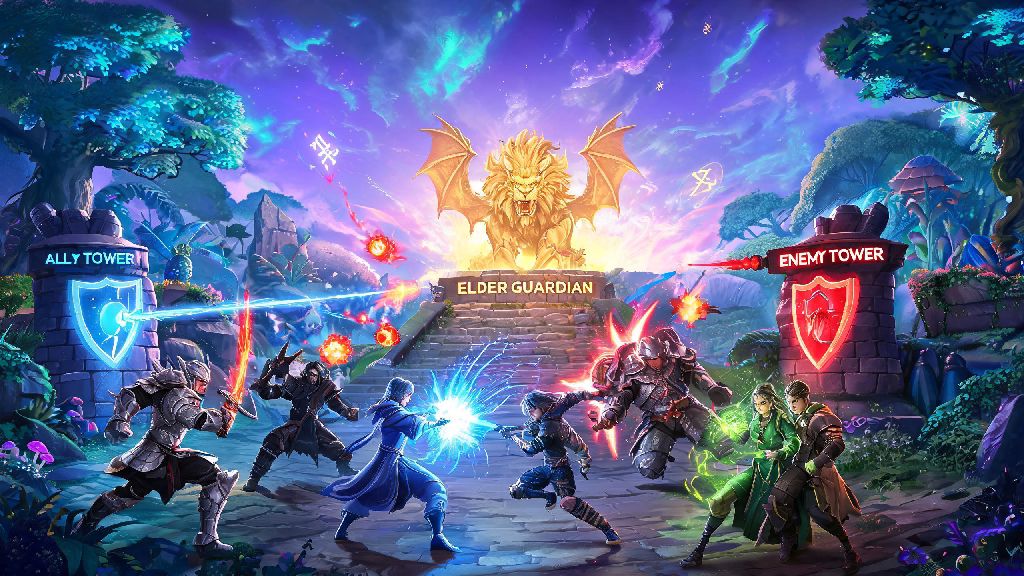
If you’ve only recently dipped your toes into online multiplayer gaming, you’ve almost certainly heard the terms “League of Legends” and “MOBA” thrown around interchangeably by friends, streamers, or forum users. You might have even found yourself asking is league of legends a moba after sitting through a friend’s 20 minute rant about how their jungler forgot to take Baron Nashor. A lot of new players get confused by genre labels, especially when games have so many different modes and features that overlap with other types of games. We’re breaking down exactly what the MOBA genre entails, how LoL fits the criteria, and why there’s so much confusion around its classification in the first place.
What Core Traits Define a MOBA Game?
Before we can answer whether LoL fits the genre, we first need to lay out the non-negotiable traits that make a game a MOBA, short for Multiplayer Online Battle Arena. The genre evolved from real-time strategy mods in the early 2000s, and over time, a clear set of shared features emerged that separate MOBAs from RPGs, RTS games, and other multiplayer titles. Not every game labeled a MOBA has every single one of these traits, but all core entries in the genre hit all four core points below.
You might notice that these traits leave a lot of room for variation, which is why there are so many different types of MOBAs on the market right now. Some have faster match times, some have more complex item systems, and some add silly limited-time modes that change up the core loop. None of these variations disqualify a game from being a MOBA, as long as it sticks to the four core rules we listed. You can add or tweak features for casual play, but the core structure remains the same across all legitimate MOBA titles.
How Is League of Legends a MOBA, Exactly?
Now that we have the core MOBA criteria laid out, it’s easy to see how LoL fits every single point perfectly, even with all its unique modes and updates over the years. Let’s start with the standard game mode, Summoner’s Rift, which is the mode used for all professional LoL esports matches and most casual ranked play. Summoner’s Rift is a classic 5v5 MOBA map with three lanes, 12 defensive turrets per team, a wide jungle with neutral objectives like Baron Nashor and Dragons, and a core Nexus structure that teams have to destroy to win. There’s no deviation from this structure in standard play, no matter what rank you are or what champions you pick.
Every player controls one of over 160 unique champions, each with four signature abilities and a specific role on the team, from tanky frontliners to high-damage mages. You earn XP for killing enemy minions, champions, and jungle monsters to level up your abilities, and gold to buy items that make your champion stronger for the rest of the match. Once the match ends, all that XP and gold disappears, and you start fresh the next time you queue up. I’ve played over 1,200 LoL matches across casual and ranked queues, and every single Summoner’s Rift game follows this exact core MOBA loop, no exceptions. That’s exactly why the answer to is league of legends a moba is so clear cut, even when people argue about its casual modes. Even alternative modes like ARAM, Arena, and URF stick to most of these core rules, just with small adjustments to make the gameplay faster or more silly for casual players.
Common Misconceptions That Make People Doubt LoL’s MOBA Status
Even with all that clear evidence, you’ll still find people online arguing that LoL isn’t a real MOBA, and that usually comes down to a few common misconceptions that have spread over the years. The most common one I hear is that LoL is too casual to be a MOBA, usually from players of older, more complex MOBAs that have steeper learning curves and harsher punishment for mistakes. The MOBA genre doesn’t have a required difficulty threshold to qualify, though, and accessibility doesn’t erase the core genre traits. A game doesn’t have to make you rage quit every third match to count as a MOBA, no matter what veteran Dota 2 players might tell you.
Another common misconception is that LoL is an RPG because of its deep champion lore, account level progression, and cosmetic mastery skins. It’s easy to see where that confusion comes from, since LoL has a lot of RPG-adjacent features for players who want to engage with the story or show off their main champion. But all that progression is either cosmetic or tied to unlocking new champions to play, and it never gives you an in-match power advantage over other players. Champion power in LoL is always tied to in-match performance, not account level or how much money you’ve spent on skins. That’s a key difference from actual RPGs, where permanent progression directly impacts how strong you are in combat.
Some people also mix it up with RTS games because you have to manage minion waves and map vision, but unlike RTS titles, you never have to build structures or control more than one unit at a time. The only unit you control directly is your champion, which is a core MOBA trait that separates it from RTS games entirely. You don’t have to manage a base or train units, you just have to focus on playing your champion well and working with your team to hit objectives.
How League of Legends Stands Out From Other MOBA Titles
Just because LoL is a MOBA doesn’t mean it’s identical to every other game in the genre, and its unique tweaks are part of why it’s become the most popular MOBA in the world. The biggest difference between LoL and older MOBAs like Dota 2 is its lower barrier to entry for new players. LoL has simpler mechanics, fewer complex item interactions, and less punishing punishment for small mistakes like missing a last hit on a minion, so new players don’t get discouraged as easily when they first start. That doesn’t mean it’s less competitive at high ranks, though—professional LoL matches are just as strategic and high-skill as matches for any other MOBA on the market.
LoL also has a far wider range of casual game modes than most other MOBAs, which makes it accessible to players who don’t want to commit to 40 minute long competitive matches all the time. You can queue up for a 15 minute ARAM match if you only have a short break, or play limited-time modes like URF that turn the game into a chaotic, ability-spamming mess for fun. LoL has the largest active player base of any MOBA in the world, with over 180 million monthly active players as of the latest public data, so you’ll almost never wait more than a minute to find a match no matter what mode you play. That’s a huge plus for casual players who don’t want to sit around in queue for 10 minutes just to play a quick game.
If you’re thinking about trying MOBAs for the first time, LoL is a great starting point, but it’s also a good pick if you care about esports. Its annual World Championship tournament is one of the most watched esports events in the world, with over 150 million unique viewers tuning in for the finals most years. Just remember that if you start playing, you should probably turn off all chat for your first 100 matches, unless you want to get yelled at for picking a “troll” champion by a random teammate who’s definitely not just mad they missed three skill shots in a row. You can also play with friends if you want to avoid toxic randoms entirely, which makes the experience far more fun for new players.
So if you’ve been asking around trying to figure out if League of Legends is a MOBA, the answer is a definite yes. It hits every core requirement of the genre, while adding its own unique twists that make it accessible for new players and engaging for long-time competitive fans. You don’t have to worry about genre labels too much if you’re just looking for a fun game to play with friends, but knowing that it’s a MOBA can help you find relevant tips and guides to get better faster. If you’re ready to try it out, start with a few bot matches to get the hang of your champion’s abilities before you jump into matches against real players, and don’t take toxic teammates too seriously.